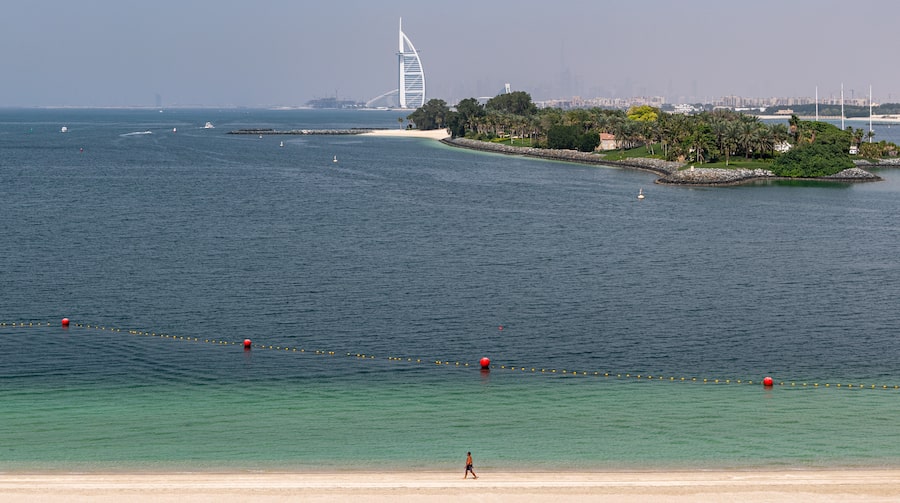
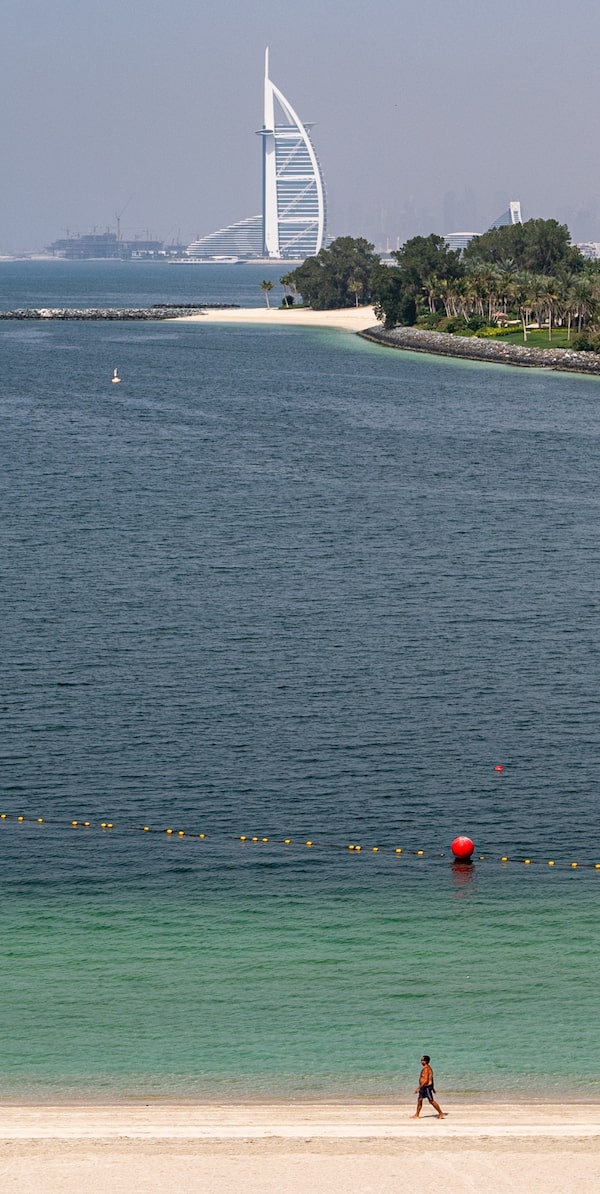
The 28th-floor beachfront apartment with wraparound windows overlooking the Persian Gulf had been one of the things that had made the Sajan family’s move from Vancouver to Abu Dhabi seem idyllic.
But now their home feels like a target – perched directly across the Gulf from Iran’s shoreline batteries, the Sajans’ location in the capital of the United Arab Emirates places them close to the petroleum facilities, U.S. military bases and multinational corporations that Tehran spent a month and a half targeting with hundreds of drones and missiles, some of which were shot down right above them.
When Phairis Sajan’s neighbours told her they’d be loading their mattresses into the elevator and spending their nights in the underground parking garage, she knew that worry-free Gulf life was a thing of the past.
And when she learned that most of her daughter’s Grade 12 classmates and all of her teachers had fled to other countries, Ms. Sajan and her husband knew that their ambitions – his, to work as an emergency-ward physician another five years; hers, to open a bookstore-café in the neighbourhood – would have to be abandoned, or at least severely reduced.
“All those thoughts were just pushed aside, and we realized that we’d need to change some plans,” Ms. Sajan said one afternoon after another sleepless night of drone-strike alerts.


Those who live and work in Abu Dhabi’s skyscrapers have been wary of air-strike alerts since the war with Iran began on Feb. 28.
Not just for millions of middle-class expats like the Sajans, but for thousands of international companies and millions of temporary labourers, there is a feeling that the region’s decades-long run as a secure, high-technology hub for the world’s commerce and connections may be jeopardized.
For many, that realization took a while to dawn.
“It was probably two weeks after it started, we realized that this would not be a short-lived thing,” Ms. Sajan said. “That’s when we started talking about leaving – if it continues, we have to get out before the summer’s over.” They’ll go back to Vancouver for a while. And if the Iran conflict breaks out again, they’ll likely cut their ties completely.
For eight of the past 14 years (they had a four-year stint in Vancouver after 2020), the Sajans have been able to enjoy a day-to-day life in almost every respect like the one they’d had in Canada. They’re surrounded by an estimated 60,000 other Canadians in the UAE. They’re able to frequent the same kinds of stores, bars, restaurants and yoga classes they do at home – they even have a choice of more than 100 Tim Hortons locations – but with much nicer weather, cleaner streets, better infrastructure and no income tax.
These are the features that have attracted millions of middle-class Westerners to the cities of the Persian Gulf, along with thousands of major companies that have come to see the Emirati cities Dubai and Abu Dhabi – as well as Doha, Qatar, and Riyadh, Saudi Arabia – as ultra-connected global hubs for finance, technology, retail and entertainment industries; as locations for international conferences and sporting events; as havens for the world’s wealthy; as major tourist destinations and gathering places.


Some UAE residents fled in such haste that they abandoned their pets. Anna Jentgen of Dubai adopted two dogs via a community project called No Pet Left Behind.Rula Rouhana/Reuters
For five decades, the Arab monarchies of the Persian Gulf (Bahrain, Kuwait, Oman, Qatar, Saudi Arabia, and the United Arab Emirates) have been protected by an invisible security umbrella, largely held aloft by the heavy U.S. military presence there.
That umbrella has allowed them to imagine a new economy and way of life beyond the extraction and export of hydrocarbons. Indeed, the UAE is probably the world’s most successful postpetroleum transition economy, with barely a quarter of its substantial GDP now coming from extractive industries.
This global-hub status has vastly improved the UAE’s living standards, which are by many measures higher than most Western cities, providing the ruling monarchy a source of popular legitimacy.
And then, on the night of Feb. 28, that security umbrella suddenly became a bullseye.
The U.S. military bases that had more or less quietly protected the Gulf States for more than half a century turned hostile, becoming launch pads for an unannounced and unprovoked U.S.-Israeli attack on Iran, and then targets for retaliation by a furious Tehran regime, which also placed the data centres, office buildings and AI labs of multinational corporations onto its target list, in a deliberate effort to fracture the safety net that had kept the Gulf dream alive.
Ms. Sajan echoed the views of many overseas CEOs when she said she found no fault in the Emirates government, which managed to shoot down at least 98 per cent of the projectiles and keep shops and supermarkets well stocked. “I have complete faith in where we are, in their defence system,” she said. “It’s proved itself. What I worry about is the external: Iran and the United States. There’s not a lot of logic.”
Iran’s six-week barrage of ballistic missiles and Shahed attack drones was aimed not predominantly at Israel or at U.S. warships – in fact, 83 per cent of those projectiles headed to the Gulf Arab kingdoms, emirates and sultanates that aligned themselves with, or even tolerated, the United States and its allies.
Hardest hit was the UAE, which was on the receiving end of 438 ballistic missiles, 2,012 drones and 19 cruise missiles, according to its Ministry of Defence, most of them aimed at civilian infrastructure, predominantly oil and gas facilities.
Thirteen people in the UAE died, all but two of them foreign labourers without citizenship, a group that makes up almost 90 per cent of the country’s population.


One of Iran’s targets in the UAE was Dubai’s port of Jebel Ali, at top on Feb. 26, and at bottom obscured by smoke on March 2.Planet Labs PBC via AFP/Getty Images
Aside from the human tragedy, the economic and psychological toll has been profound. The Gulf became disconnected from the global economy on a scale not seen since the peak COVID crisis of 2020; international companies, some explicitly threatened by Tehran, shifted their staff and operations to other hub cities such as Singapore temporarily and began serious discussions of permanent relocations.
Countless billions of dollars’ worth of events and meetings and deals were cancelled or postponed. The Bahrain and Saudi Arabia Formula 1 Grand Prix, one of the world’s biggest sporting events, was cancelled. And the business calendar remains blank, out to the fourth quarter of 2026 and beyond, because nobody knows when the war will really be over, when the Strait of Hormuz will really be safe, when Iran will no longer be a threat and allies of the United States no longer a target.
Looming over the region is a darker possibility – that normal times may not return at all, and the Gulf party may be over for good. Although most businesses and expats, including the Sajan family, told me they were impressed with their host country’s ability to protect them with interceptors, they are now permanently aware that something like this could happen again. Underlying any multinational business decision, any relocation plan or hosting strategy, is the knowledge that the gleaming cities of the Gulf have just ended a half-century role as impeccably safe oases.
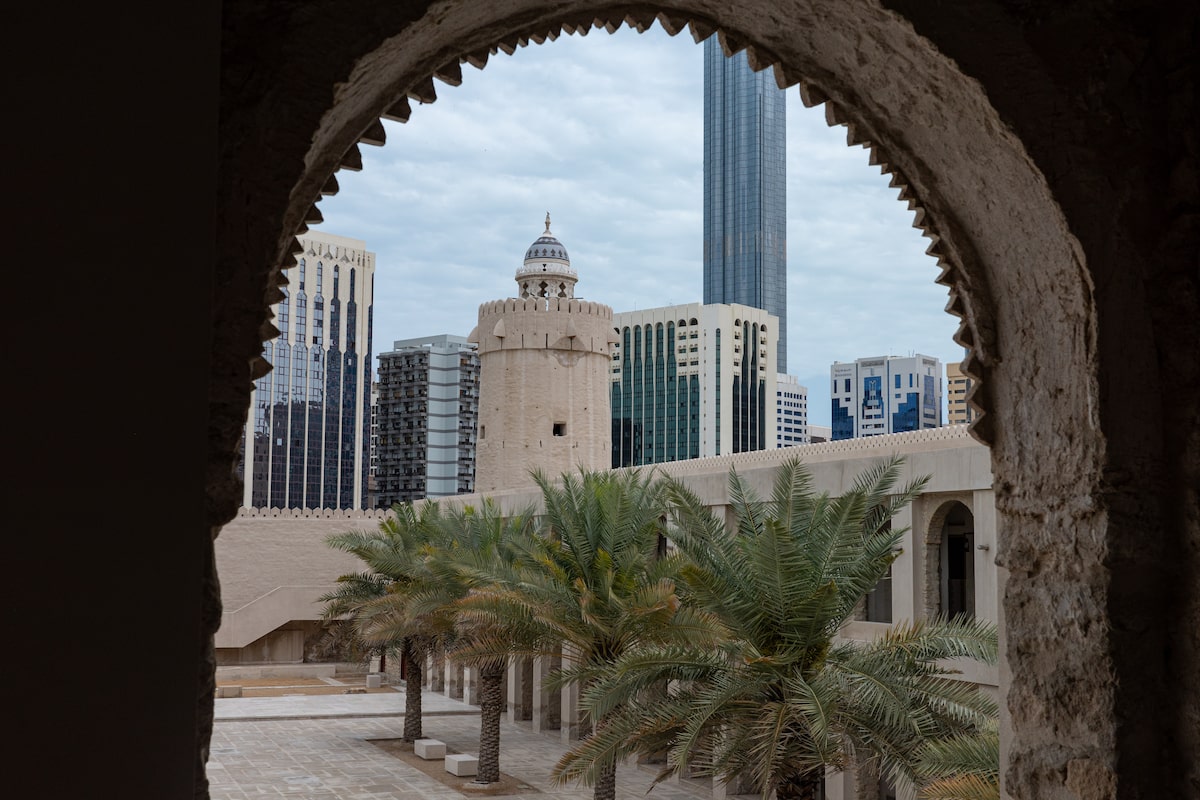
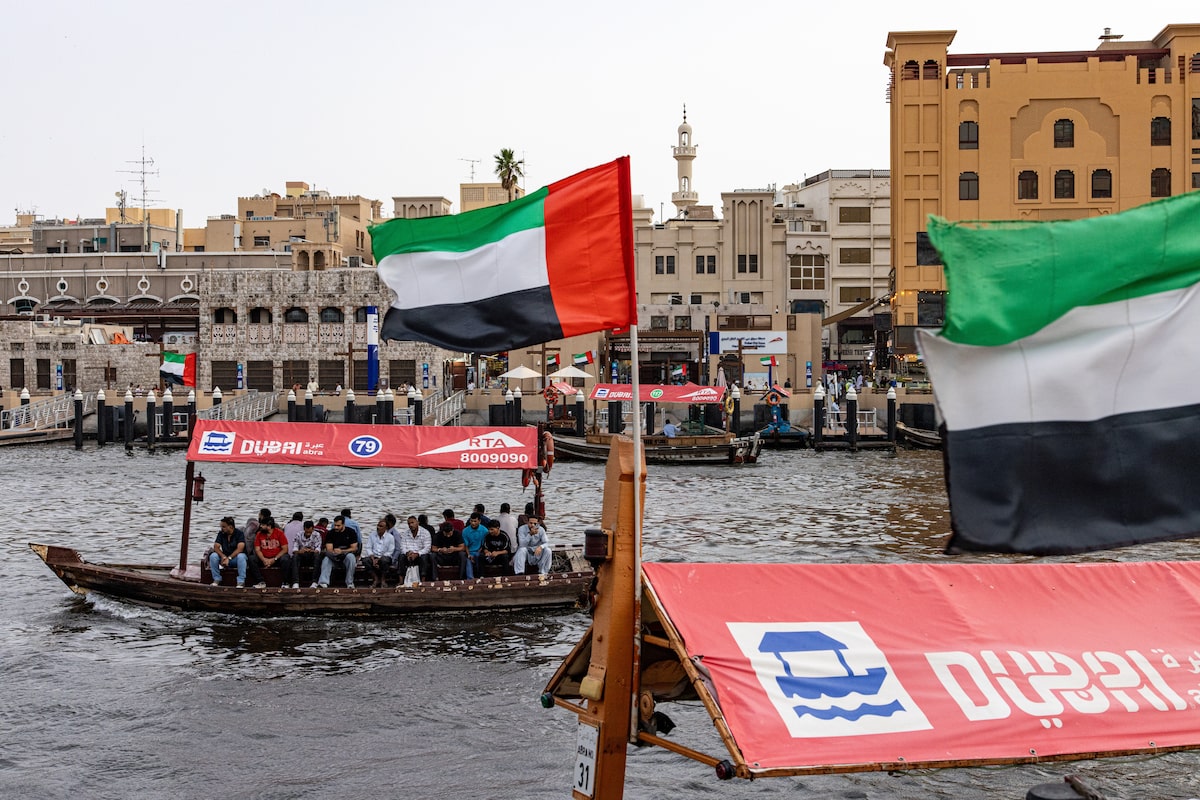

The Gulf security bubble emerged as an accidental side effect of the Cold War’s superpower machinations. Though Washington had provided security guarantees to the region’s petro-states from the end of the Second World War, until the 1980s this was mostly done by arming up its two most powerful regional allies, the Kingdom of Saudi Arabia and the Shah’s Iran.
That changed when Iran was seized by Islamic militants hostile to the United States in 1979, followed, within months, by the Soviet Union’s invasion of Afghanistan. President Jimmy Carter responded by making the security umbrella a hawkish official policy: Any further attempt to seize Gulf countries would be treated as a domestic attack on the United States and repelled with the Pentagon’s arsenal. Within a decade, the Carter Doctrine had resulted in mammoth U.S. air and naval bases in Saudi Arabia, Bahrain and the UAE.
That forward presence would propel two Iraq wars and numerous lesser military adventures. Those bases provided an answer to a question that loomed over the Gulf during the late 20th century: how to remain prosperous kingdoms when the oil ran out – or when the world economy moved away from petroleum.

The U.S. military operates from an air base near Abu Dhabi, Al Dhafra. Some of its buildings were visibly damaged by Iranian fire in this satellite view from March 15.Airbus Defence and Space via AP
The Saudis tried investing countless billions in a range of industries abroad and megaprojects at home. The Emirati rulers, drawing on their cities’ preoil history as trading ports, saw more promise in those cities becoming platforms for the profitable activities of outsiders. They invested heavily in their country’s infrastructure and architecture, launched a major airline and an airport that was to become the world’s busiest for international flights, welcomed fleeing money from the shadiest and most heavily sanctioned places, adapted themselves to the wild and dissolute ways of the well-off West, and watched Dubai and Abu Dhabi become bywords for anything-goes globalization.
In the view of the Emirates’ ruling class, it was this very success, more than the military bases, at which Tehran was firing its drones.
“I think this is possibly why the UAE was targeted more than anyone else in this conflict: It’s because of our model that brings the world here,” said Mohammed Baharoon, the well-connected founder of the Dubai Public Policy Research Centre. “Whereas Iran wants to kick the world out … The fact that they’re trying to weaponize connectivity is an acknowledgment of what connectivity means for us.”

Dubai's Burj Khalifa, the world's tallest building, was unharmed in the fighting with Iran.Fadel Senna/AFP via Getty Images
At least some of Iran’s drone and missile strikes were clearly intended to threaten the Dubai model and the Gulf States’ future viability as global hubs.
In early April, the Islamic Revolutionary Guard Corps designated 18 U.S. and allied technology companies – including Apple, Microsoft, Google, Meta, Oracle and IBM – as legitimate military targets destined for strikes; many of them shut down operations and moved employees out of the region. Amazon was forced to suspend deliveries across the Gulf and close its Abu Dhabi fulfilment centre after its Amazon Web Services data centres in the UAE and Bahrain were struck by drones.
Likewise, the IRGC broadcast threats of “complete and utter annihilation” against the planned US$30-billion Stargate UAE project in Abu Dhabi, a massive 1-gigawatt AI data centre campus funded by OpenAI, Oracle and Nvidia.
It’s hard to gauge to what extent these threats have harmed the UAE’s corporate image as a safe harbour. It is clear, from conversations with Emirati elites, that they believe another attack on this scale could jeopardize the whole national project – and that they urgently need to pivot away from their exclusive security relationship with the United States.
It is not lost on anyone here that all this economic devastation and human tragedy are the result of an inexplicable decision by the current U.S. President to launch air strikes on Iran with no specific end goal. Though they are too diplomatic to put it that way in public.
“The analogy I use is that the security umbrella has holes in it,” Mr. Baharoon says. “Instead of throwing it out and buying another one, we’re just patching it. We’re patching it with relationships with other countries. We’ve looked into air defence from Korea, we’ve looked into collaboration with India ... There have been patches, and part of it is our own internal capacity-building.”
The Gulf countries are also deepening their relationships with Pakistan (Saudi Arabia has entered a NATO-like collective-defence pact with Islamabad), China, and Russia – one of the potential longer-lasting consequences of Donald Trump’s decision.

If you want to gauge the long-term effects of the Gulf bubble’s rupture, there’s no point asking the CEOs who do business here. With a future resolution unclear, and even the stability of the ceasefire far from certain, nobody is making statements or answering questions.
Better to ask someone like Natasha Hatherall-Shawe. She runs one of Dubai’s largest marketing and public-relations firms, and her 70 employees organize many of the events, conferences, product launches and big-retail extravaganzas that, in normal times, bring jetloads of people to the Emirates every day.
She nearly became one of the many expats who fled the country – on the first full day of the conflict, March 1, she watched in shock from her apartment in the stem of Palm Jumeirah (the huge housing development that looks like a palm tree from the air) as a hotel down the street was struck by a missile, in one of the first Iranian strikes, and belched flames and smoke.
“I actually had a bit of a meltdown and went and bought 300 cans of food,” she laughs. But she insisted on staying in UAE, because there was a huge amount of work to be done, almost all of it in cancelling big, complex events that filled the Dubai calendar in the weeks and months ahead, right into the fourth quarter.
Beyond Ms. Hatherall-Shawe’s sphere, some of the largest Emirates events that have been postponed or cancelled include the 50,000-attendee Middle East Energy exhibition, the 13,000-person Megacampus Summit and the cryptocurrency industry’s 15,000-attendee Token2049 conference.
Some companies have confidently shifted their events into 2027, she says. But most are just waiting to see what pans out.
“I think a lot of people and companies right now are just on pause,” she said. “From every level – marketing, communications, new contracts – everything is very much in a holding pattern. Decisions are not being made. I had a really big pitch from a big retailer, and the CEO said, ‘Look, we want to sign a contract, but it could all change in a week or two.’ … It’s going to be hard for us to see much significant movement because a lot of brands are just watching and waiting.”

Also watching and waiting for an end-of-war announcement that may never fully arrive are a lot of tourists and millions of business travellers, and therefore a lot of airlines, hotels, restaurants, Uber drivers, cooks and hotel staff – almost all of them temporary labourers from South Asia, East Asia and Africa.
For one of those labourers, a slight young man named Faisal, the war came as a particularly personal blow. Much like those big corporations and middle-class expats, Faisal, 23, was forced to change his plans dramatically. In his case, that meant postponing his future family life, potentially for years.
Three years ago, Faisal (we are not printing labourers’ surnames or employers because they can be penalized for speaking with the media) had come to Dubai from the city of Peshawar, in northern Pakistan. He had landed a job in the kitchen of one of Dubai’s sleek business hotels, a coveted three-year contract that paid him $800 a month under the Emirati “Kafala” (sponsorship) contract system, which generally ties employees to a specific employer. Though the kitchen work was beneath his college education, it paid more than middle-class jobs back in Peshawar.
For almost two years, Faisal and his family had been saving to pay for his wedding. He hasn’t seen his fiancée in more than a year, as he’s been putting off visits to save the flight cost. Her family had planned the event for October, even booking a palatial Pakistani wedding pavilion in which to hold it.
But after the near-total collapse of Gulf tourism in early March, Faisal’s hotel cut his pay to 20 per cent, and there’s no sign of when it might return to full. He’s luckier than Edouardo, a Filipino man of the same age who is Faisal’s roommate in the hotel-company dormitory near the edge of the city. Edouardo was put on full furlough, with no pay (but accommodations and meals continue to be provided), and fears he may be repatriated in the coming weeks, since residency without employment is not generally allowed.
He’d be part of a huge exodus. India’s government alone has reported the repatriation of more than 220,000 of its citizens from the Gulf since March 1. So great is the outflow that the UAE this month revised its 2026 population-growth estimate downward from 5 to 1 per cent.
Faisal is staying, but his fate is more personal.
“It was really a sad day for my whole family when I had to call to tell them to cancel the wedding,” Faisal tells me. “We only needed a few more months’ pay, but I don’t know when that will be coming. We will not be married in 2026 or 2027. That is fate, I suppose – I will be an older man by the time I’m a husband. We just have to make different plans.”

Katherine Iscoe, a Canadian citizen, says she's reassured by the UAE's response to the war and does not plan to leave her home in Palm Jumeirah.
That, to a greater or lesser degree, is a conclusion that unites the Asian workers and the middle-class Westerners and the big corporations here: They don’t believe the Dubai model has come to an end, but they do realize that, thanks to Mr. Trump, they won’t be able to keep doing things the old way.
That was something very quickly realized by Kingston native Katherine Iscoe, a business consultant who makes her living giving motivational speeches, writing life-management books and providing coaching to organizations and groups.
Unlike her neighbours, Ms. Iscoe didn’t feel the need to flee the country, even though she also witnessed the projectile strike on the hotel. Like fellow Canadian Ms. Sajan, she was comforted by the success of the UAE interceptor arsenal in shooting down anything incoming.
“They did a good job of realistically making people feel reassured,” she said. “I don’t think anyone thought those were only fireworks in the sky; we were very clear on what was happening, but they made us feel safe.”
But there was a sense, in the strange air of calm and normality that descended over the Gulf after the first few days of attacks, that something had been lost.
“Some of us had to go through a bit of a mourning period, because we were angry at the ‘tangerine tyrant’ for doing this,” she said, “especially those of us who were just getting settled in.”
But after the moment of grief came a time of adaptation – after cancelling a lot of speaking events both in UAE and abroad, she re-engineered her practice, moving things online and hoping for the best.
“You have learn to be agile – it’s like the pandemic, when a lot of organizers and businesses became more open to appearing on screen rather than in person. It’s given us a good shake, but it’s also future-proofed us by forcing us to find other ways of earning income. Right now, it’s like, let’s just get through this.”
That is essentially the view of just about everyone in the Gulf States right now. It extends right up to the monarchs and clans who rule them, and who have had to adapt to the sudden discovery that their principal defender is now their leading existential threat.
Their bubble has cracked, their umbrella frayed. And in their effort to maintain the profitable illusion of a pristine safe haven, they’ll turn to more reliable partners outside the democratic world.

The conflict in context: More from The Globe and Mail
The Decibel podcast
If hostilities ramp up again in the Middle East, Hormuz is not the only strait worth worrying about, explains Thomas Juneau, an expert on Yemen at the University of Ottawa. He spoke with The Decibel about the Bab el-Mandeb, and what would happen if Iran or its Houthi allies limited access to it. Subscribe for more episodes.
From our correspondents
Analysis: Ceasefire in Lebanon could be a turning point
How oil built and defined the Gulf before disrupting it
Why Hormuz has been a commerce chokepoint for centuries
Editor’s note: An earlier version of the story incorrectly said Natasha Hatherall-Shawe left the United Arab Emirates. She did not leave the UAE for any period. This article has been corrected.