Sam Eagan is a New York-based journalist covering politics, masculinity and sport. He is a former NCAA division-one wrestler for the University of Wyoming and a current Muay Thai fighter.
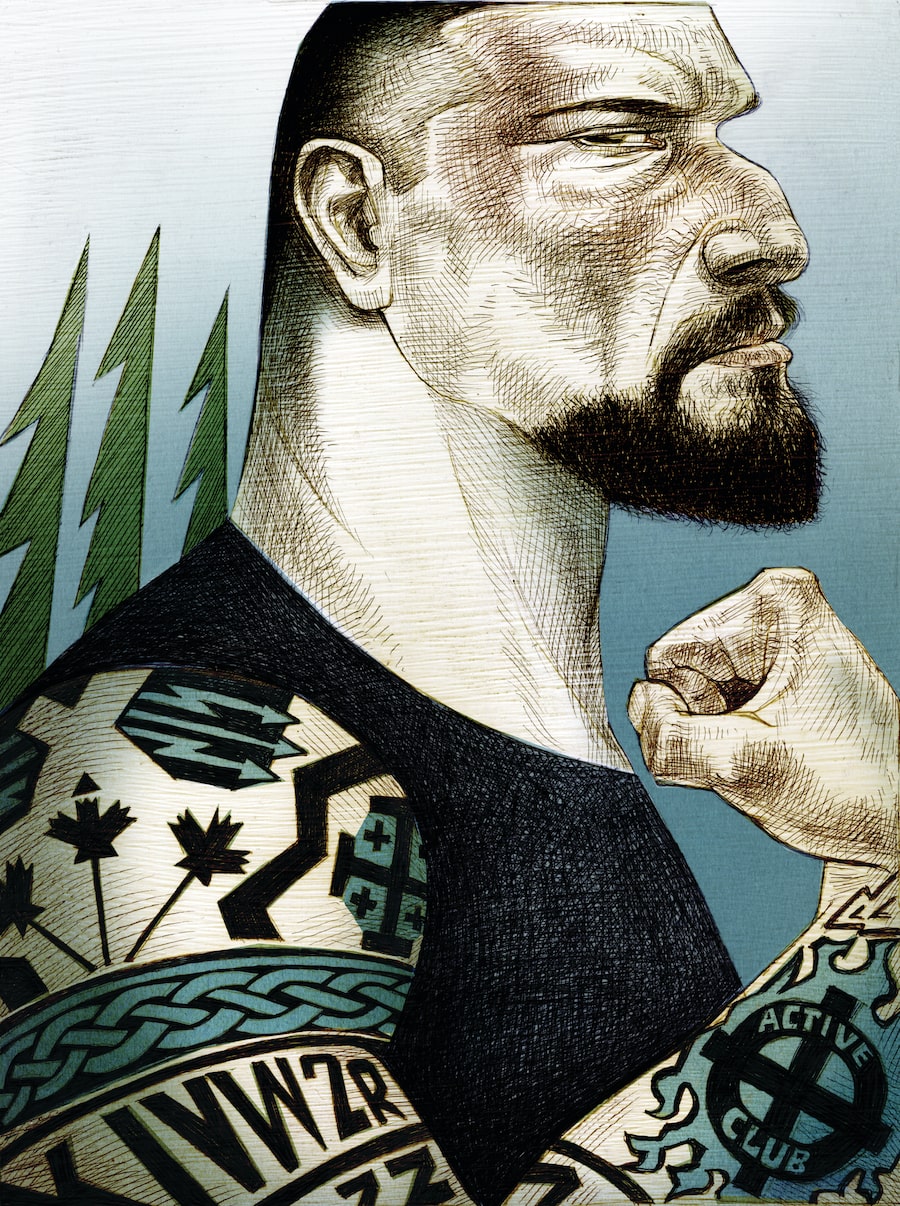
“Let’s go to where I stabbed this dude,” Robert Rundo tells the camera outside a convenience store in Queens, N.Y., wearing a backward hat and sunglasses as he aggressively chews gum.
In the short propaganda video for his California-based Rise Above Movement, which was posted in February, the native New Yorker is almost gleeful as he recalls the moment. In a detailed play-by-play of this “street warfare” incident, he describes how, in 2009, he battered and stabbed an alleged member of a Salvadoran-American street gang known as MS-13 over a territory dispute in his childhood neighbourhood. The camera shakes while the 36-year-old delivers his stand-up; the footage, which appears digitally altered to look gritty, is interspersed with images of him doing pull-ups with his shirt off and boxing in a gym. The video’s bland title, “Where I’m From: White Working Class Queens,” gives the game away in its opening text: “A fascist in the concrete jungle.” “Fascist” is clearly not meant derogatorily.
“A lot of people think I’m a bit of a street criminal. I don’t think so,” Mr. Rundo says defiantly. “In my mind, I was just a Roman legionary getting rid of some … barbarian invaders.”
That peek into his mind is telling. In 2017, Mr. Rundo was charged with planning and engaging in political riots in California, and he fled to Europe to avoid U.S. authorities. While there, he turned the Rise Above Movement into a global, decentralized white-supremacist network of what are now called Active Clubs. Centred around mixed martial arts, the clubs offer people (predominantly men) places to work out and revive “the spirit of the warrior” in the face of what he believes to be a coming race war, among like-minded – and like-skinned – people. “I’m a nationalist,” he says in an interview later in the film. “It means I put my people first … people of European heritage, descent.”
Eventually, in 2023, he was extradited back to the U.S. from Romania, but would only be sentenced to time served. And now, thanks in part to videos like this one, Active Clubs have become an international movement, with more than 187 chapters in 27 countries. In Canada, there are at least 30 chapters, including a Frontenac, Que.-based Active Club discovered by The Tyee in a Montreal gym in March, organized by one of its now-former boxing coaches. There is a significant amount of intermixing and co-ordination between them; U.S. Active Club members have visited Hamilton, Ont., to network with a local neo-Nazi group, and earlier this year, members of Canada’s biggest white nationalist group travelled south to meet Mr. Rundo, according to a CBC investigation. That appears to be working: analysts say that the far-right is more unified than ever. “This shows that this problem of white supremacy is not isolated to Canada alone and that the white supremacist groups in Canada are not operating within geographical silos,” Steven Rai, senior research manager at the Institute for Strategic Dialogue, told the CBC.
And last summer, a white-nationalist conference in Vancouver – promoted to people “serious about rebuilding strength, culture, and brotherhood in an age that’s actively hostile to all three” – drew fascists and white supremacists, as well as MMA gym owners, coaches and trainers. One headlining speaker was Paul Waggener, the American cofounder of the Wolves of Vinland, who is among the most influential thought leaders in the far-right today. “Make no mistake, we are at war,” Mr. Waggener reportedly told his Canadian audience. “And the war is physical in many ways for some of us, but it’s also cultural and it’s a war for the mind.”
This is the threat that Active Clubs pose today: they are taking aim at the hearts and minds of young men, who have grown increasingly disillusioned and drawn to the “strength, culture and brotherhood” they offer. Mr. Waggener, Mr. Rundo and other white nationalists have found a way to move in from the fringes by merging their ethos with broader ideas around masculinity and physical fitness – a cultural space situated at the heart of male culture that has been almost completely vacated by the global left. The fast rise of Active Clubs shows that they do so at their peril.

To understand the appeal of Mr. Waggener and Mr. Rundo’s ideology, one must first understand how radically the world has changed for today’s young people. They came of age during the COVID-19 pandemic and its painful, isolating lockdowns; now, they’re watching as AI increasingly shuts them out of the work force, while being stuck in a sputtering economy that has caused deep instability. Many have resigned themselves to the reality that they will never own a home. Amid surging unemployment rates, many have been forced to do ungratifying service- or technology-related work that doesn’t help them close the growing affordability gap.
These issues have hit young men particularly hard. In both Canada and the United States, men under 30 are more likely to be unemployed than women. The percentage of young Canadian men who reported “very good” or “excellent” mental health fell from 70 per cent to 52 per cent between 2012 and 2022. Canadian men are now less likely to attend university, which remains a crucial place in which to make friends and meet others, and far more likely to die deaths of despair.
It is little wonder that men, in particular, are grasping for control over the parts of their lives where they can still maintain a sense of agency. The most extreme versions of this have manifested themselves in the rise of looksmaxxing (the optimizing of hypermasculine facial features, sometimes through dangerous means), injectable peptides (a multi-billion-dollar industry that has also expanded into an unregulated grey market that introduces serious health risks), and the skyrocketing popularity of plastic surgery globally.
But weightlifting, running, martial arts and other fitness cultures are among the few remaining places where an individual’s output generally corresponds directly to how much they put in. If you lift weights, for instance, you will generally get stronger, and if you run, you will get faster – and there’s something satisfying and important in that.
The innovation brought by today’s white nationalists is the way they’ve smuggled poisonous rhetoric into workout spaces. Much of it is influenced by an Italian far-right philosopher named Julius Evola, who argued that the world rotates through four cycles, ending in an age of materialism and decay that he attaches to the rise of proletariat communism. The late Evola argued that, in preparation for the arrival of that age (the “Kali Yuga”), the spirit must be cleansed through discipline, suffering and warfare. Mr. Rundo’s Active Clubs are premised on this thinking, while Mr. Waggener launders much of this ideology through combat sports, operating a Lynchburg, Va.-based Brazilian jiu-jitsu gym.
Both Mr. Rundo and Mr. Waggener have also cultivated a self-help guru image that fits in with many of the fringier figures of the broader manosphere. Mr. Waggener sells powerlifting programs designed to turn you into a “panzer tank,” a book designed to help readers survive the Kali Yuga, a children’s picture book titled You Are Your People, and personal-coaching calls that cost US$150 an hour. And in addition to his Clubs, Mr. Rundo operates an online lifestyle brand that sells clothing, including a crewneck emblazoned with the Evolan expression “Ride the Tiger,” an adaptation of a Hindu allegory in which the tiger represents the Kali Yuga’s inevitable violence.
It is not difficult to understand why some of this rhetoric might resonate among some young men. In Canada, 46 per cent of people aged 25 to 44 reported having difficulty meeting financial needs, with hopefulness for the future on the decline. More than 111,000 full-time jobs have disappeared since the start of the year, and youth unemployment has grown to 14.3 per cent. For the first time in generations, it’s expected that young people will experience a lower standard of living than their parents. And it doesn’t help that governments are spending much more on those 65 and older in Canada, which has the second-highest median age of any Commonwealth country. For young people, this is all evidence of that social decay – and of a society that seems increasingly geared toward caring for a wealthier and older population, at their expense.
While you might argue that these statistics don’t actually reflect decay – that these are the result of changing gender norms, the simple reality of an aging population, and a reshifting of our economic engines – this argument is complicated, and can feel like it ignores men’s very real anxieties about where they fit into these new structures. The new white-nationalist movement offers simple solutions that speak directly to these concerns for young white men.
This social club/combat sports model is tailor-made to target men craving a communal experience amid all these systemic worries. “Active Clubs are appealing to some young men because they frame white supremacy as a project of becoming stronger, healthier and more disciplined,” Mr. Rai told me. “At a time when many young people feel overwhelmed by social and economic instability, these groups offer a simple explanation for why the world feels broken, a clear enemy to blame, and a seemingly productive way to respond.”
The pain and gain that extreme physical fitness offers can give young people a way to thrive in these difficult times. Today’s white nationalists understand this power, connecting their political ideology to physical activities that can and do tangibly improve people’s lives everyday. That’s why the slow and belated responses by governments around the world – including in Canada, where the federal government announced a strategy in February aimed at the mental and physical health of boys and men, which is scheduled to launch in June – have a disadvantage. After all, when you can move quickly to help people make their lives materially better, the more they trust you.

Some politicians, particularly on the mainstream right, have also borrowed from the playbook. Fitness, weightlifting and combat sports, for instance, have been central to the growth of the MAGA movement; Health Secretary Robert Kennedy, Jr. and Defence Secretary Pete Hegseth were filmed doing the “Pete and Bobby Fitness Challenge” late last year, and U.S. President Donald Trump has made the Ultimate Fighting Championship a key feature of his movement, with a UFC event planned for the White House’s south lawn next month. This has allowed the 79-year-old Mr. Trump to link himself, by proxy, to young men who are handsome, physically fit, and capable of the kind of domination that appeals to so many in the MAGA camp.
Conservative Party Leader Pierre Poilievre has also made fitness an explicit part of his brand, appearing in videos with his personal trainer and declaring that “hard work should pay off – in the gym and the economy.” He even gifted podcast host Joe Rogan a custom-made kettle bell in an appearance on his show in March, appealing directly to Mr. Rogan’s huge audience of predominantly young men: “I think we do have to promote fitness more. It turns [people] into a subject that controls their surroundings, rather than an object being controlled.”
There is nothing inherently left- or right-wing about fitness. Indeed, people who wake up at 6 in the morning and lift weights, or run 10ks in the summer sun, are the very definition of hard-working. And young people are clearly willing to be tenacious and disciplined when they are not alienated from their labour, showing that they are in fact the exact kind of people who can be spurred to take action, and represent a potential base that craves direction and an opportunity to substantively improve their lives. Yet the American and Canadian left are years behind on efforts to make inroads with these voters. Research suggests that people with left-wing politics generally perceive overtly masculine and physically fit candidates negatively, and that political leaders with defined musculature are inherently perceived as being conservative. This has cultivated a political environment where anything fitness-related has become seen as downstream from the “bro” qualities that progressives tend to disdain, and that politicians thus try to avoid.
This is not tenable. Gen Z is the fittest generation in modern measurement, with over 30 per cent of them regularly working out in fitness spaces, compared to 15 to 20 per cent of the rest of the population, according to one British industry report; simultaneously, they are increasingly health-conscious, as they drink and party less than before. As a result, weight rooms, Pilates studios and Brazilian jiu-jitsu gyms have become prime spaces for the dissemination of ideas. If Mr. Rundo and Mr. Waggener can launder neo-Nazi ideology through these powerful channels, then the left can – and must – meet people in these places and spread their values there, too.
That shift is now under way in the United States. Democrats are putting significant financial backing behind fitness influencers, and many of their candidates have begun diving into that space. In Michigan, senatorial candidate Abdul Al-Sayed posted a video of him lifting with prominent fitness influencer Mike Israetel, while New York Democratic Congressional candidate Cait Conley announced her campaign with a moodily lit video of her bench-pressing in slow-motion. While former NDP leader Jagmeet Singh used gym imagery in last year’s federal election campaign to promise to “fight” for Canadians, there has been little effort to grab this brass ring among the Liberals and NDP.
Mr. Rundo represents a dangerous and ahistorical idea of what it means to be a warrior. But if the left does not channel its own version of that kind of ethos, the reality is that the far right will continue to dominate those rooms.