In the agricultural heartland of B.C.’s Fraser Valley grows 11,500 square-metres of immaculate sod: a precision blend of Kentucky bluegrass and perennial ryegrass, chosen for its dense, carpetlike structure and tolerance of temperate climates.
In the coming weeks, this deep green field will be harvested and loaded into two dozen refrigerated trucks that will depart hourly for Vancouver. There, the sod will be installed at BC Place stadium, where it will form one of 16 playing fields for the 2026 FIFA World Cup.
Millions of dollars and years of research have gone into making sure this pitch meets the global soccer governing body’s exacting standards in what will be the most logistically complex and geographically dispersed tournament in World Cup history.
Every playing field must behave similarly – from how far a ball rolls on it to how much shock it absorbs under a player’s foot – regardless of whether that field is in coastal Vancouver, hot and humid Miami, or high up in Mexico City, 2,240 metres above sea level.
“People think, ‘Oh, it’s just grass. You’re bringing in some grass,’ ” said Tony Valente, a councillor for the City of North Vancouver and senior director of infrastructure and capital projects at BC Pavilion Corp., which owns and operates BC Place.
“This is not grass. This is an entire system of devices, of buildup. It is complex – far more complex than people realize.”
The Globe and Mail spoke with industry experts and technical specialists to get a behind-the-scenes look at how a World Cup pitch is built – and why growing grass is one of the most complex challenges for the world’s largest sporting event.


John Sorochan studies turfgrass at the University of Tennessee, which advised Bos Sod Farms on how to meet FIFA’s demands.Jessica Tezak/The Globe and Mail
For John Sorochan, the journey began in the fall of 2018 at a café in central London. A distinguished professor in turf grass science at the University of Tennessee, the Calgary native was meeting an industry colleague and was excited to tell him about a graduate student’s work on turf composition and ball-bounce dynamics. The research involved launching soccer balls at different grass types as high-speed cameras captured every frame.
His colleague, Alan Ferguson, had other ideas for their discussion. Four months earlier, the FIFA Congress had awarded the 2026 World Cup to Canada, the United States and Mexico – the first time the tournament would be spread across three nations.
Around the same time, a restructuring at FIFA brought pitch management in-house, and the organization tapped Mr. Ferguson to oversee every pitch associated with its tournaments globally. The gregarious Scotsman previously served as the head groundsman for England’s Football Association, where he was in charge of pitches at St. George’s Park and Wembley Stadium.

The 2026 World Cup spans three countries, each with its own colour on the official ball: Red for Canada, green for Mexico and blue for the United States.Jessica Tezak/The Globe and Mail
For the 2026 World Cup, Mr. Ferguson would be responsible for 16 stadiums – some domed, some open – in three countries, across different climates and elevations. Eight artificial turf fields would have to be converted to natural pitches. Existing natural pitches would have to be upgraded to meet FIFA specifications. They would require different grass varieties, maintenance methods and a multitude of other considerations.
In contrast, all eight stadiums in the previous World Cup in Qatar were located within an hour’s drive of each other. For that tournament, FIFA had turned to a small research facility in Doha to design the optimal pitches for the country’s hot and dry climate. Mr. Ferguson wanted to scale up that kind of work for the North American tournament.
“Quite simply, coming from the smallest FIFA World Cup footprint in Qatar, in 2022, to the biggest one in 2026 was already presenting some very unique challenges,” he said at a news conference in February. “And we needed to come up with a plan to deal with that.”
Over tea and biscuits at the London café, Mr. Ferguson told Dr. Sorochan that he wanted to ensure uniformity across every stadium using evidence-based research. And, he wanted him to lead that research.
Dr. Sorochan gulped.
“Like an idiot, I said yes immediately, without even knowing what the consequences were,” he recalled in an interview. “I was never going to say no.”

Dr. Sorochan drafted a proposal and Mr. Ferguson brought the idea to FIFA, which would ultimately invest more than US$5-million on research and infrastructure for the five-year project.
It is the largest sports-turf research program for soccer and a first-of-its-kind initiative by the organization.
With the ball rolling, Dr. Sorochan thought back to his years as a student in the turf grass management program at Michigan State University. During that time, he was part of a team responsible for the World Cup’s first indoor natural grass pitch, at the old Pontiac Silverdome near Detroit in 1994.
He phoned his former professor, Trey Rogers, who led that project, and asked if he would help.
“He didn’t even flinch,” Dr. Sorochan said. “He’s like, ‘I was gonna be retired by then, but yes.’ ”
As project leads, the two scientists then brought on university faculty, technicians, support staff and students. About two dozen candidate cities were still in the running at this point, which made apparent the scope of potential venues, but didn’t allow for stadium-specific planning. They started broadly, later focusing their efforts when host cities were confirmed.

Dr. Sorochan's challenge was to find out how to grow sod in advance, for a variety of climates, that could be installed easily.Jessica Tezak/The Globe and Mail
The two universities shared insights from research that had already been under way. UT, for instance, had been trialling a “shallow-pitch” profile. Instead of stitching synthetic fibres 18 to 20 centimetres deep into the rootzone below a grass surface – a common practice to strengthen a playing field and improve stability – recent developments made it possible to install the fibres at a depth of as little as 4.5 centimetres.
This meant that a thin layer of sod could now be grown on plastic and stitched in advance, simplifying both installation and removal, while reducing the amount of synthetic fibre required and the associated costs.
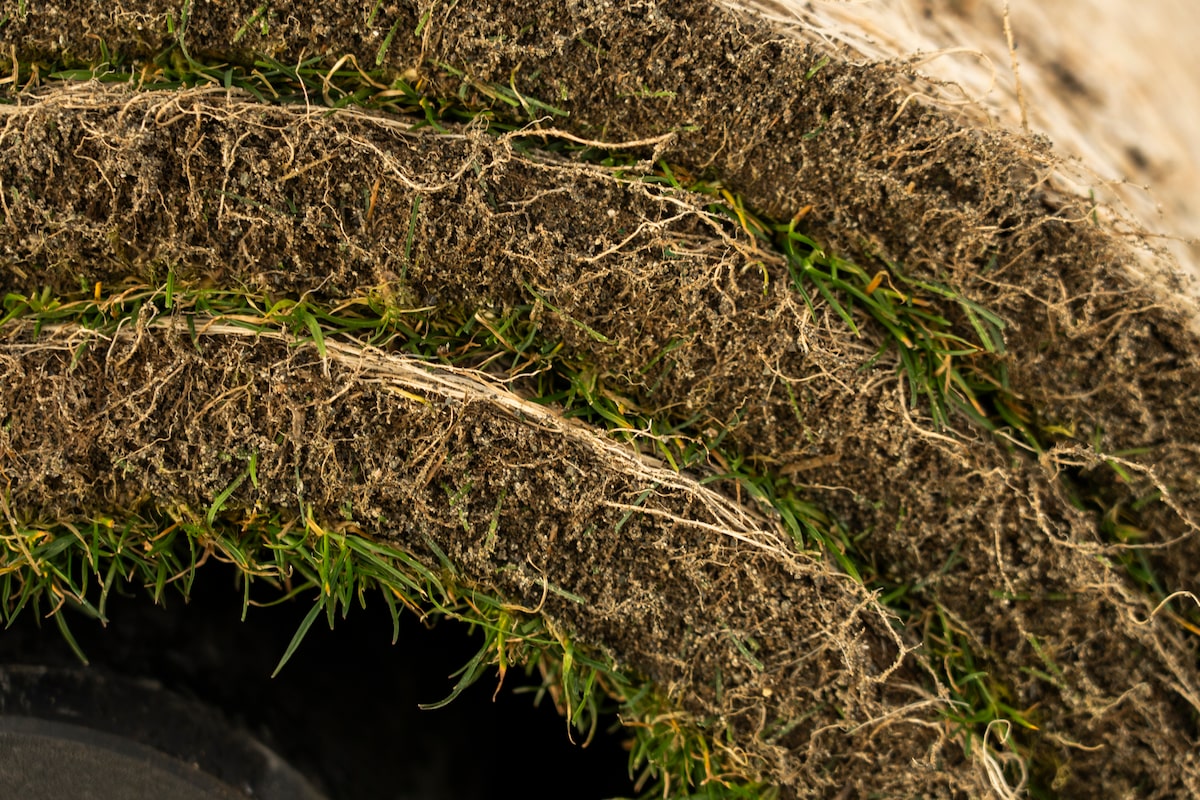
For stadium applications, the team decided early on it would use sod grown on sheets of impermeable plastic, rather than directly in soil. The method results in a dense and intact root mass that easily lifts off the plastic at harvest, eliminating the need to cut the roots, which can cause damage and transplant shock.
The sod-on-plastic method was used at the 1994 World Cup and was a focus of Dr. Sorochan’s master’s research at MSU.
In 2026, warmer cities would use bermudagrass, a low-maintenance grass chosen for its tolerance of heat and drought. Temperate cities would use cool-season Kentucky bluegrass, blended with fast-germinating perennial ryegrass to improve stability and boost disease resistance. Though they are distinct grass types that thrive in different climates, the two variations can be cultivated to achieve the same performance benchmarks required by FIFA.

Dr. Sorochan tests sod with a time domain reflectometry probe, which measures moisture in the soil.Jessica Tezak/The Globe and Mail
To test their turf, the researchers constructed two facilities: a “shade house” at UT to simulate conditions inside a domed stadium and assess grow lights, and a 23,000 square-foot asphalt pad at MSU to study how turf behaves when laid over a stadium floor.
Fresh in Dr. Sorochan’s mind was a 2018 NFL marquee matchup between the Kansas City Chiefs and the Los Angeles Rams that had to be moved to Los Angeles from Mexico City because of unsafe field conditions. The hybrid playing field at the former Estadio Azteca stadium had passed the league’s testing standards at the time, but after heavy rain, a big concert and some soccer matches, the sod lifted underfoot “like a comb-over in the wind,” he recalled.
To prevent such a disaster in 2026, they would need to test not just surface hardness and rotational resistance, which relates to traction, but how the turf responds to a player’s step. To do this, Dr. Sorochan and UT research scientist Kyley Dickson created a portable machine to simulate an athlete’s foot strike, complete with a 3-D-printed foot outfitted with sensors and wearing a real cleat.
With the help of metal workers and mechanical engineers, as well as experts in computer science, kinesiology and biomechanics, they calibrated the device to simulate impacts from athletes of different sizes. They collected data on the field’s condition and how much energy the surface returned, rather than absorbed.
It was this device that confirmed that the shallow-pitch system they had been experimenting with performed the same as a standard pitch with 12 inches of sand beneath. The finding meant stadiums that typically use artificial turf would be able to quickly and cost-effectively install natural-grass pitches – a development that Dr. Sorochan called a “wow moment.”
(The shallow-pitch profile was used for several 2025 Club World Cup stadiums, though this year’s World Cup venues will use traditional builds to accommodate additional pitch requirements.)
The university’s research foundation helped Dr. Sorochan and Dr. Dickson patent and market their turf-testing technology, which they called the fLEX Device. In the years since, it has been used to test more than 130 stadiums connected to the NFL, MLB and other leagues in five countries.
When host stadiums for this year’s World Cup were confirmed, the team began doing city-specific outreach and testing. The Mexico City stadium replaced its traditional Kikuyu grass, native to Kenya, with a Kentucky bluegrass and perennial ryegrass mix. Toronto’s BMO Field, which already had a natural grass pitch, installed new Kentucky bluegrass reinforced with synthetic fibres.
The turf scientists conducted inspections of each stadium, and held field days with FIFA staff and host-city groundskeepers to provide updates on research activities and take questions.

Meanwhile in B.C., Bert Bos was stressed. It was January, 2024, and FIFA had notified the specialty turf grower that his family-run business in Abbotsford was being considered to grow and install the World Cup sod at BC Place after recommendations from industry colleagues.
Mr. Bos had been in the grass-growing business for more than 30 years and was no stranger to exacting standards, having supplied picture-perfect sod to golf courses and sports fields throughout Western Canada and the U.S.
But FIFA was a different beast. He had not, for instance, grown sod on plastic before, and wondered if that would even be possible in a region that receives as much rain as Abbotsford does. He asked other growers if there could be holes in the plastic to allow for drainage, receiving mixed replies.
“That was really a tipping point,” he said in an interview at the sod farm. “If there was no perforation, I think we’re playing with fire.”

Bert Bos is a 30-year veteran at growing grass.Paige Taylor White/The Globe and Mail
Mr. Bos was invited along with other prospective suppliers to visit both UT and MSU, where he learned about FIFA-specific grass systems and grow lights, and that, yes, the sod can be grown on perforated plastic.
Back at home, his family grew a test plot to FIFA specifications and documented the process with photos. He was pleased to see it turn out well.
Bos Sod Farms was awarded the contract. The seeds were sown last June, over coarse sand and perforated plastic. Vancouver is one of three cities using a “hybrid-carpet” system, in which roughly 95 per cent natural grass is grown on 5 per cent synthetic backing, eliminating the need to stitch the fibres in after installation. Los Angeles and Philadelphia are using the same system.
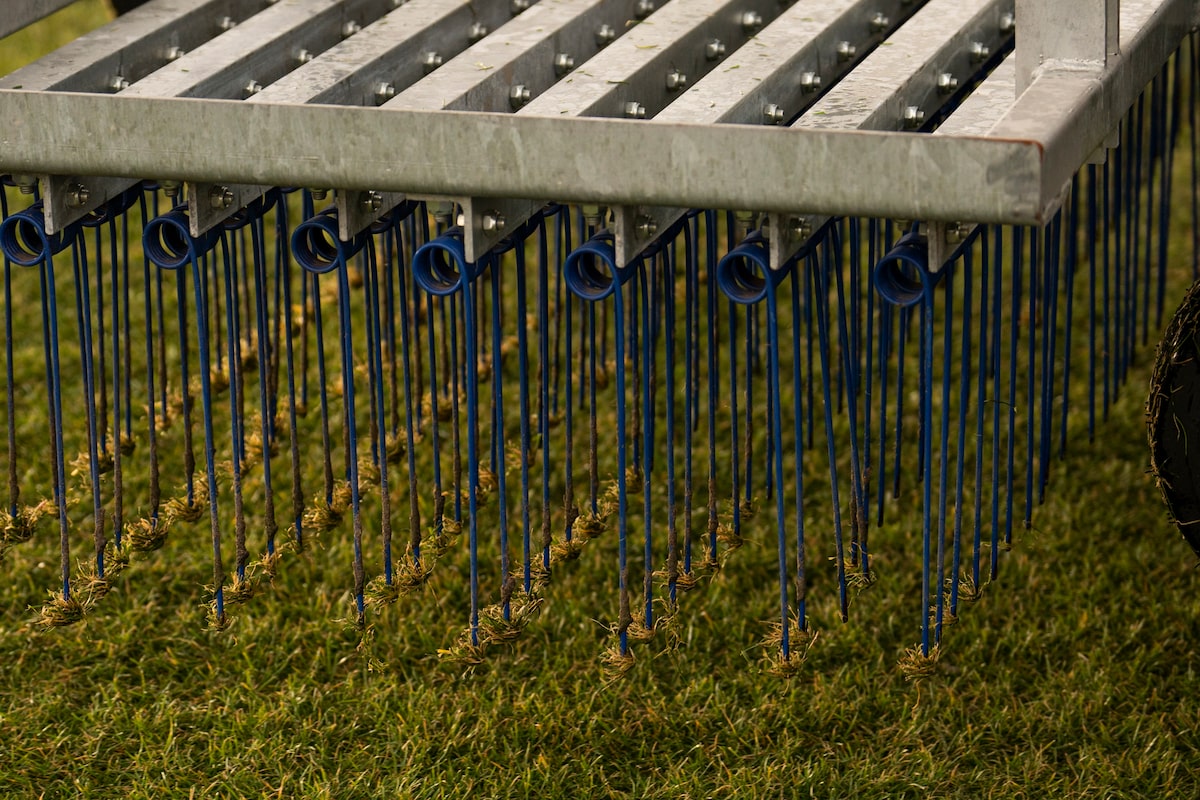
The Bos family has raked, mowed and vacuumed the sod for organic matter every two weeks during the growing season, clearing away the debris that can block water from draining and compromise the surface. Moisture levels are checked three to five times a day. The year-long growing process, required by FIFA, ensures the sod is mature and consistent.
Mr. Bos called it a once-in-a-lifetime opportunity to do a project of this calibre.
“It’s a reflection of our business, of course – but also the turf industry in B.C., the city of Vancouver, the province of B.C. and the country of Canada – that we’re able to grow this high-quality turf in-house,” he said.

When the sod arrives at BC Place stadium in May, it will be installed atop 340 millimetres of sand and peat, layered over a foundation of stacked polymer geocells and a waterproof liner. Within the rootzone will be a network of sensors connected to high-speed irrigation and vacuum ventilation systems that can saturate and drain the field in three minutes flat.
Ten grow lights, each weighing more than 1,800 kilograms, will be brought on to the field for 12 hours a day. Six industrial fans, nearly 600 kg each, will blow air at a minimum of eight kilometres an hour, ventilating the field to prevent root rot and fungal growth.
The grass will be mowed to exactly 22 mm. Cutting it even a few millimetres too short would stress it, potentially destroying the field. (Bermudagrass, on the other hand, must be mowed to 16 mm; any longer and it would slow a soccer ball’s roll.)
Half a field of reserve sod will remain in Abbotsford, just in case.

BC Place will be able to count on some sod reserves in Abbotsford if anything unexpected happens.Paige Taylor White/The Globe and Mail
The BC Place team will have four weeks to prime the pitch to the highest level of play.
To do this, BC Pavilion Corp. partnered with Burnaby-based civil engineering and consulting firm R.F. Binnie & Associates Ltd. on design and construction management.
PavCo’s Mr. Valente said the goal was to keep as much investment as possible within B.C. and Canada, both as a Crown corporation and in consideration of U.S. tariffs and political tensions. In addition to the Fraser Valley-grown sod, Langley’s Wilco Civil Inc. is constructing the field of play, and Vancouver’s ETRO Construction has undertaken 12 separate projects to renovate the stadium.
“At the same time, we also knew the importance of supplementing these local vendors with the best international expertise,” Mr. Valente said.
Catherine Eiswerth, Binnie’s vice-president of sports, recreation and open spaces, said her firm worked with specialists from the U.S. and Britain with extensive experience in World Cup pitch construction, drawing on their expertise to design the overlay and ventilation system at BC Place to FIFA’s standards.
“We can’t chance anything going wrong,” Ms. Eiswerth said, adding that everything has to be perfect for “the most important sporting event in the world.”

Dr. Sorochan, working with his fLEX machine in Knoxville, hopes that five years of research will pay off for players and fans.Jessica Tezak/The Globe and Mail
Reflecting on the process weeks before kickoff, Dr. Sorochan noted that both UT and MSU are land-grant universities, which means they were established as a result of land or funds provided by the government, with a charge to provide research, education and outreach to the broader community.
He called the five-year research project “historic” for bringing together top experts to find new ways to tackle the World Cup’s biggest challenges.
“This is going to make life and lives better, not just for athletes who play on these surfaces, but hopefully for the fans that watch and enjoy the games,” he said.
Eight years after pitching the idea to Dr. Sorochan at the London cafe, FIFA’s Mr. Ferguson said he was assured through the process by the dedication and expertise of the team leading the project.
“Probably the best cup of tea we’ll ever have,” he said.

Fields of interest: More on soccer from The Globe
Ahead of the Game podcast
When Qatar last played host to the World Cup, its final showdown between Argentina and France was a thriller for the ages. You can relive it with The Globe’s limited-series podcast from 2022.
Soccer in depth
FIFA World Cup machine keeps rolling no matter what
Why did FIFA cancel thousands of hotel bookings in host cities, including Vancouver and Toronto?
Cathal Kelly: Canada has no more excuses after being handed a World Cup cakewalk