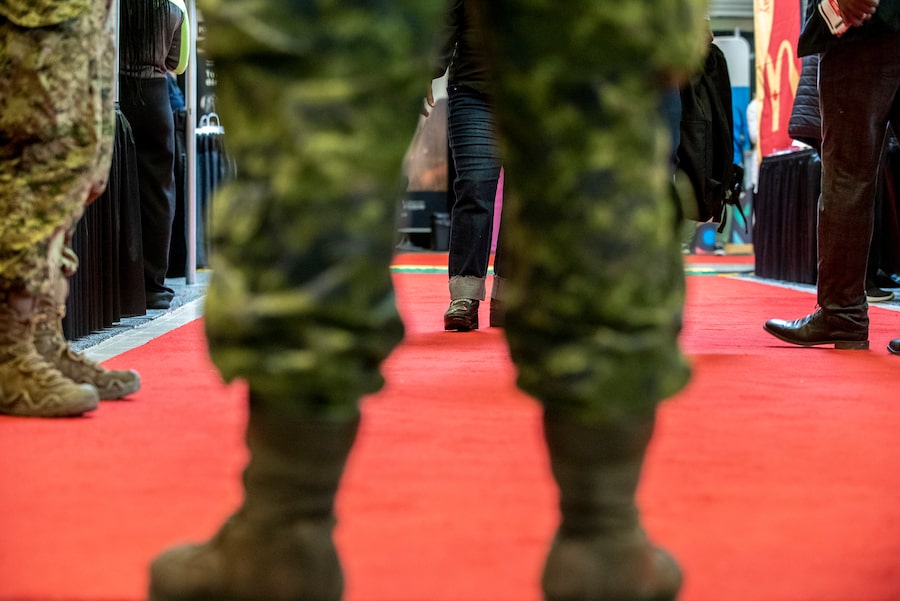
Joyce Mbongo walked away from a military recruitment table at a career fair near Montreal recently knowing exactly what she wanted to do with her life: join the Canadian Armed Forces.
The 17-year-old had already started an application but wanted to talk to recruiters to learn more. She’d thought about it for the past couple of years, she said. “Something just stopped me, like, leaving, going really far from my family, and the training also really scared me, but now I know that that’s what I want to do,” she said, standing between booths on the fair floor.
Mainly, she wants to serve her country. “I fear that there will be a war because of what’s happening, you know?” she said, referring to the United States and the war in the Middle East. “So I’m really scared that maybe it will come here. What are we gonna do if we’re not ready? So I just want to make sure that I know what to do and then I can protect the people I love.”

Joyce Mbongo's curiosity about the military, and anxiety about global geopolitics, drew her to a job fair in Terrebonne, Que.
The Canadian Armed Forces is seeing a surge in recruits. The Department of National Defence said that over the past year the CAF enlisted 7,310 new members, exceeding its target of 6,957. It’s the highest number of recruits in more than 30 years.
But the rise in enlistments is not indicative of a sudden interest in the military, defence experts say. Previously, the challenge was administrative, with the process taking so long that some applicants would drop out. And other barriers, such as aptitude tests and medical requirements, were also prohibitive.
Charlotte Duval-Lantoine, a fellow at the Canadian Global Affairs Institute, said the military has been trying to address these problems and has focused on expanding the pool of candidates. A big change, she said, was opening the Armed Forces to permanent residents in 2022, as opposed to requiring Canadian citizenship. And since then, there have been more changes, such as axing the aptitude test and relaxing medical limitations.
“At the same time, in parallel to those changes of criteria for entry, we’re seeing the war in Ukraine erupting, we are seeing a government that is a lot more vocal about defence issues and commits to 2 per cent of GDP in defence spending. And then we see Donald Trump get elected for a second term. We see the narrative around the 51st state,” Ms. Duval-Lantoine said. “So two things are happening: increased interest, but at the same time, the military pushing itself to let more people in through the door.”

Members of all military branches came to the Terrebonne job fair. Master Corporal Luzolo Mutambala was lead recruiter for the Donnacona Laval detachment.
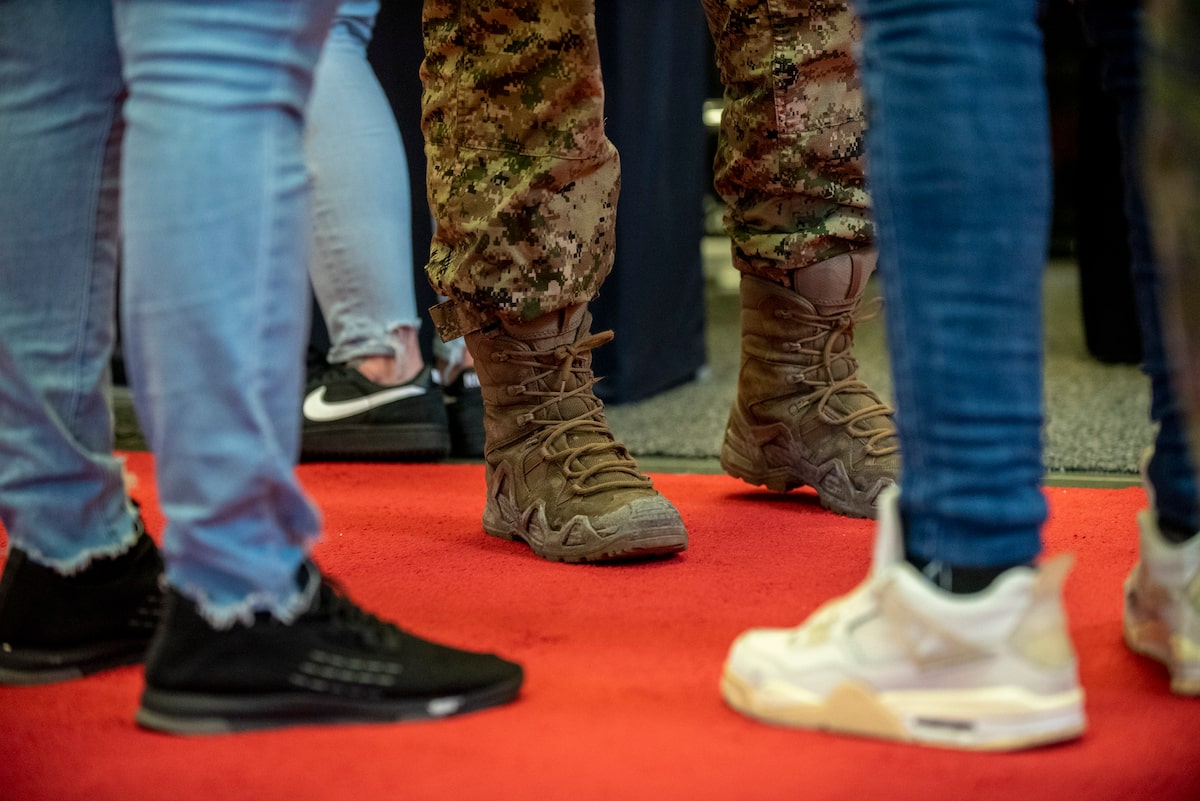
At the career fair in Terrebonne, Que., the CAF had recruiters from the Navy, the Army and the reserves on site to talk to people. At times, their booths were overwhelmed with people, which is perhaps reflective of the mood in the country.
A poll conducted by Nanos Research for The Globe and Mail and published last month found that an increasing number of Canadians would be willing to serve in the CAF if the country were to become involved in a major war.
Twenty-four per cent of respondents said they were willing to serve when surveyed in March, up from 12 per cent in November. And 58 per cent said they had a positive view of the Forces.
Lisa Tubb, a public affairs officer for the CAF, said initiatives to bolster recruitment have included an application form focused on education, work and life experience to evaluate an applicant’s suitability, as well as a more efficient online process.
A new probationary period allows applicants to undergo training while the administrative process is under way, she said.
The medical standard has been revamped, too, Ms. Tubb said. Applicants who were previously found medically unfit to serve could now be eligible.
Ms. Mbongo had her own clear reason for enlisting, but others at the career fair said they thought the military was a good job opportunity, offered stability or would make them feel they were doing something important.
Alexander Courville, 29, said that after speaking with recruiters, it was clear the military offers a lot of different opportunities − and needs people.
“I think it’s something very interesting to know that it’s not just about fighting and war, it’s more about helping people,” he said.

Moving across Canada goes with the territory in the Army, says Sergeant David Chao, middle left.
Sergeant David Chao, 45, who was recruiting for the Army, said it’s a common misconception that the Canadian Army only offers combat trades. He said logistics, medics, mechanics and electricians are also important roles.
And he tells potential applicants that if they join the regular Army, going on missions is part of the job and postings mean moving around the country.
Part of the role of the recruiter is to provide information, but also to be on the lookout for people who seem motivated and to steer people in the right direction.

Corporal Patrick Girard Martin, now 33, says he signed up in his early 20s so he could be proud of himself.
Corporal Patrick Girard Martin, who was recruiting for the reserves, said many people who approach him at career fairs are interested in human resources or communications, positions that aren’t in demand. If someone seems like they would be a good fit for the Navy or Army, he sends them to his colleagues. “We’re here to help people, and I think that’s the message I want to give people. You’re not going to join the Army and be wounded next week,” he said. As a 12-year veteran, “the only time I got wounded is because I was a dance teacher.”
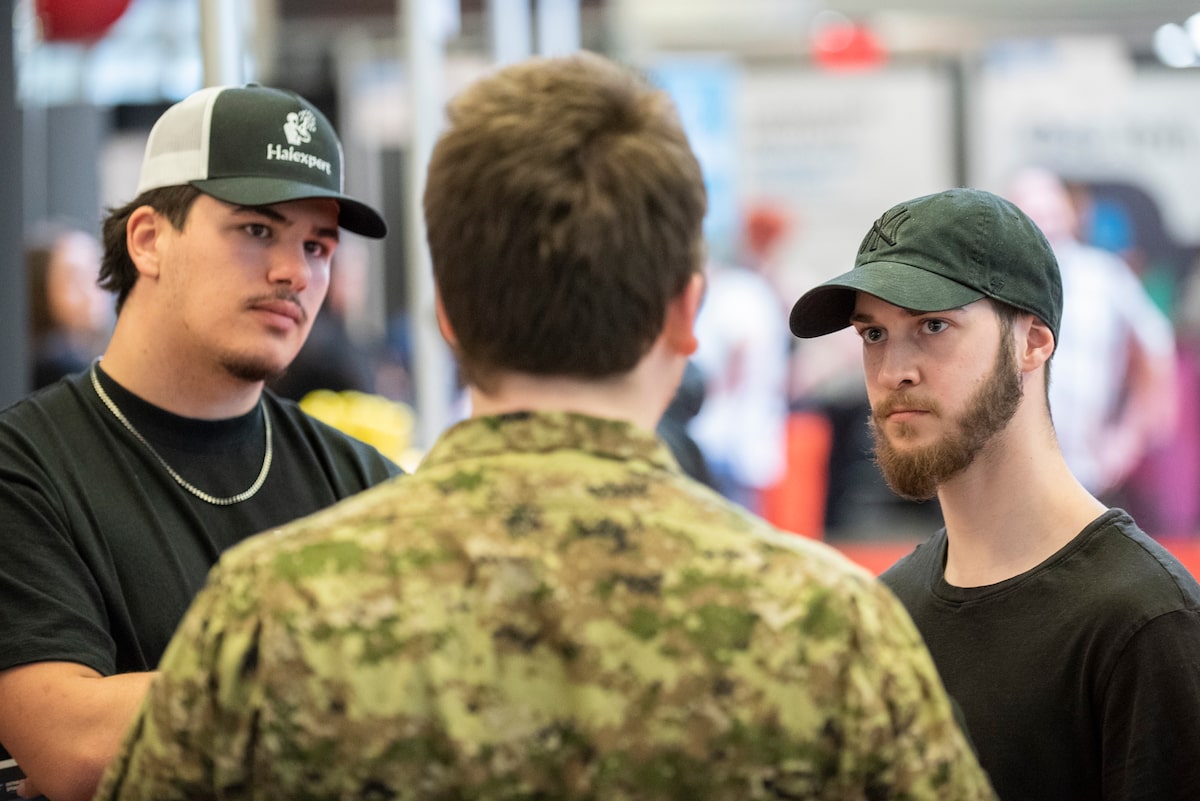
Cpl. Girard Martin said it’s also his goal at these events to give the military a positive image. Sometimes people can be intimidated to speak with soldiers in uniform, so he tries to break the ice by asking people to guess his favourite colour or by offering them a key ring. “If people feel more comfortable with me personally, it’s a win, even if they don’t join the army. If they see us in a good way, I think it’s a good thing.”
Canada on guard: More from The Globe and Mail
The Decibel podcast
What’s driving a nationwide surge in military enlistment? Reporter Janice Dickson spoke with The Decibel about what she learned at a Quebec job fair. Subscribe for more episodes. Subscribe for more episodes.
Military preparedness in focus
Success rate for basic training in Canadian military drops
NATO exercise in Latvia reveals Western alliance’s drone vulnerabilities
Snowmobile trek pits Rangers’ resolve against a ‘nightmare’ storm